
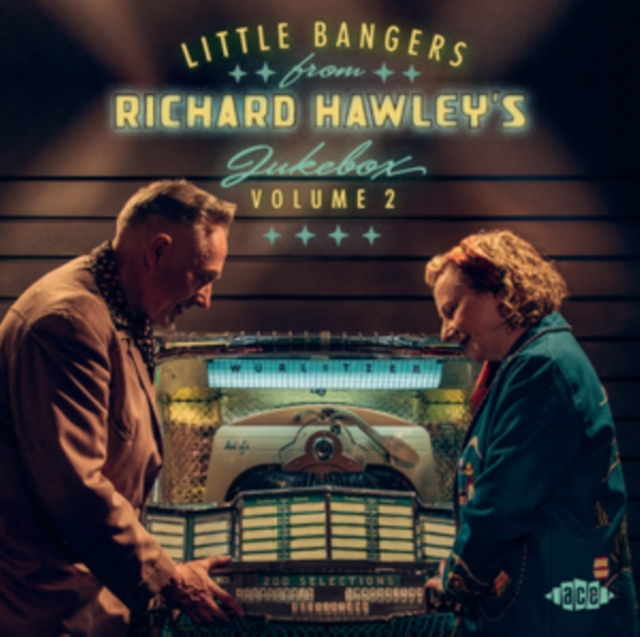
Another superb compilation from Ace Records, who over the past five decades have deep dived into multiple crates of rare and wonderful fifties and sixties bounty so extensively it is a wonder they can still put sets out of this high standard. One ingenious way of keeping the releases fresh and interesting in 2026 is the personally curated collections by a genuine connoisseur record collector, of which the vintage rockabilly styled Richard Hawley is one of the best. It all comes down to whether the headline name has a good ear and, having previously shown his credentials with volume one, you can be reassured our host is a safe bet. No surprise really, that kind of faithful mid-century sound only comes from someone with a real, heartfelt appreciation of the originals. And to give the project even more a stamp of authenticity, it is clear from Richard’s detailed accompanying anecdotes to each track that these really were 45s he listened to on his jukebox. There is even one track (‘Man From Nowhere’ by Jet Harris) that was only available on a compilation album so Richard went to the trouble of getting one copy pressed on seven inch so it could be fed into the record machine.
What I do love about this collection and Richard’s personable text is how relatable it all feels to those who crate dug around charity shops, record fairs, and boot sales all their lives. Hawley reminisces about being on tour in the US during the nineties and coming across boxes of singles selling for next to nothing in the most unlikely of places, like the forecourt of a garage. But wherever he was finding his hidden treasure, the thrill of the hunt and the joy in the payoff is pretty universal. That buzz of finding something interesting looking, on a funky unknown record label or with a curious title, taking a punt on it then getting back home and lowering the needle for the first time to discover a B-side with garage-rock gold or a freakbeat frenzy is among the highest highs you can attain as a music lover. Or thinking you have one thing that turns out to be something entirely different but equally sensational; this happened to Richard as he quite reasonably expected The Surf Riders ‘I’m Out’ to be a Dick Dale style waverider only to get a boppin’ hillbilly lament about a man with a violent girlfriend.
A theme of music beloved of Richard Hawley does not necessarily limit us to one genre or era but nevertheless, he has managed to compile a journey in sound that makes sense from start to finish. Certain tracks offer a compelling case for the rich, overlooked creativity of the post rock ’n’ roll, pre‑Beatles years. People like Chet Atkins, Duane Eddy and Link Wray all have a plentiful supply of three-minute gold dust sprinkled in their catalogues, but we are also taken down far less explored corridors too. A little-known singer called Frank Minion comes on like a New Orleans street seller in 1958, and the listener is also enlightened to the unexpected garage band vibe heard in an Elvis Presley track from 1962. The structure of the album sees it front loaded with six instrumental tunes as our narrator rightly points out how massive music without words was in the early sixties, observing that it “makes your brain think and respond in a very different way.” For me, the greatest revelations were in some garage and psych golden rarities uncovered on his travels. The Blue Rondos ‘Baby I Go For You’ is an out-and-out nugget, as is the rocking horse obscure ‘Gotta Find A New Love’ by The Yo Yo’s on the Goldwax label from 1966. And you are extremely unlikely to find one of only fifty copies pressed of Sunshine Theatre’s ‘Mountain’ from 1971, a record that defies categorization, so you might as well experience it here, as part of a dizzying 28 track re-enactment of a night round Richard Hawley’s house, listening to his most treasured audio discoveries.
Danny Neill
Order a copy of this deeply enjoyable CD here: https://amzn.to/4ruR45k
 Fruit Tree Records