
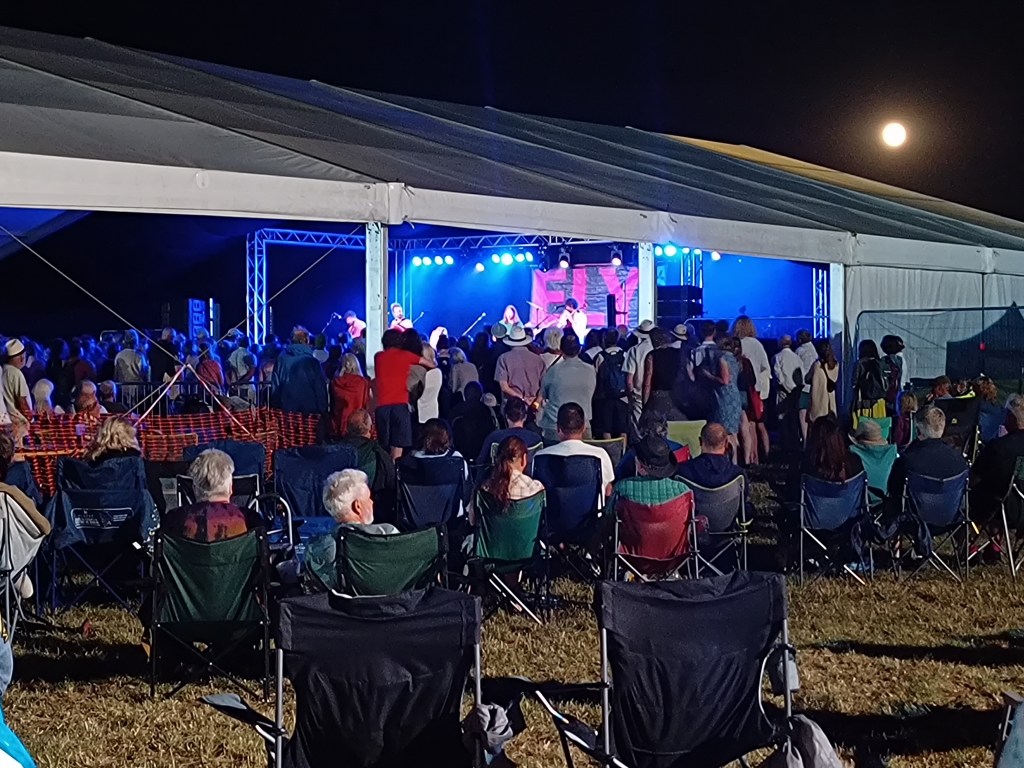
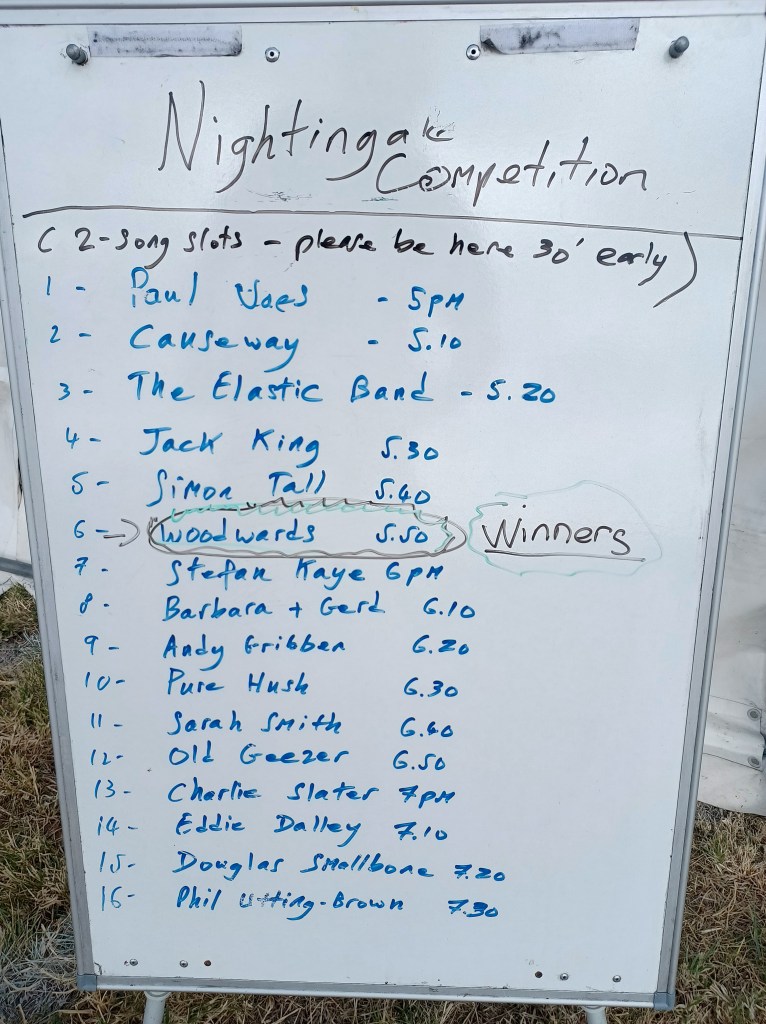
If folk music is the people’s music, as I still firmly believe it is, then the overriding mindset and spirit of the indelible movement is that of a musical community with a common language in sound and story telling expression. So, within those parameters it might seem at odds with the ethos for there to be a competitive element to any performances at a folk festival. But at first glance the Saturday evening of this thoroughly wonderful weekend jamboree appears to be staging that very thing on the Nightingale Stage, the ‘café style’ of the three stages here used for more intimate concerts and workshops. The Nightingale Competition allows sixteen unscheduled performers to sign up for two songs each after which the judges will deliberate and declare a winner whose prize is the chance to open up the Peregrine Stage, the large main arena with all the kudos of a showcase space and audience, on the Sunday morning. But far from a battle environment, there is a charming air of camaraderie to this whole session, singers and players united in a desire to encourage the best out of each other. Where some took on folk standards or singer-songwriter classics by the likes of Joni Mitchell, there was an inspiring selection of original songs on offer. In fact, it was one of these by Douglas Smallbone, an emotive song of personal trauma that not so much plucked the heart strings as smashed a power chord with them, that could easily have won the likeable Essex troubadour the night. That honour, amid other stiff competition from Barbara and Gerd (exemplary guitar work) and Old Geezer (solo vocals on a re-write of Ian Dury’s ‘Apples’) went to a hypnotising guitar and vocal duo called The Woodwards. All told, this was a wildly varied and captivating evening’s entertainment.

This has been a big year for the Ely Folk Festival, not as big as next year when it celebrates its fortieth anniversary, partly due to a massive gap in the live folk market emerging with this year’s cancellation of the neighbouring Cambridge Folk Festival. I spoke to a lot of people over the course of this weekend who would normally be at Cambridge and whilst many would no doubt attend both, there are also some who readily admit to coming to Ely in Cambridge’s absence. They also freely acknowledge that this is a festival every bit as good as its higher profile nearby event and that they intend to return. The differences are negligible, Ely is certainly smaller but with three stages filled by programmes of music, a beer tent, food stalls, market stalls, craft and family activities, generous camping areas, reliable shuttle buses from town centre to festival site and a round the clock air of jigs, reels and folk jams breaking out there is absolutely nothing lacking in the festival experience at all. There is even a Morris display that descends onto the Ely city centre. Whereas Cambridge possibly feels the commercial pressure of needing some big-name headliners, Ely by and large focuses on loading their bill with folk and folk adjacent musicians of a strong pedigree. So, in that sense Ely is arguably the destination for the purists and hardcore folk fans out there. For my money though, it is simply a situation ripe for those with an open ear for great music. I caught acts I have loved in the past and uncovered new obsessions; there was rarely a moment across the three days when I could not find audible entertainment to excite the senses.
In a weekend over populated with highlights I shall attempt to reflect on the performers leaving the biggest impression on me; the first sounds I chanced upon were 2Steps 4Words, a five piece singing original material possessing a rough hewn rustic charm that reminded me of the Trader Horne sound I love on obscure early seventies records of a similar ilk, they sing of locations visited on travels around the East of England. My first main stage sensations were Kelvin Davies & Chloe Turner, and it turns out they are one of two festival Spotlight competition winners for this year (a new development in the annual talent contest which now has a space for solo and duo entrants alongside a separate challenge for bands). These two play a darkly absorbing blend of murderous early twentieth century ballads by people like The Carter Family, their guitar and vocals are sumptuous enough, but they are also joined by the festivals most dapper man in a heat defying three-piece suit on harmonica. Back in more intimate surroundings, Martin Baxter gave off an authentic air of British folk spirit, especially with a lesser familiar version of ‘John Barleycorn’ played on acoustic guitar along with an electric fiddle and Pat (seen earlier in the act opening this stage) on futuristic drum pads.

On Saturday afternoon I paid my first visit to the Kingfisher concert stage for some affectional story telling in song from Suffolk’s EllYTree. I had pre-investigated this songwriter (real name Helen Woodbridge) before the festival and so was prepared for some deep, stirring material, accompanied by Fara on cello, and she did not disappoint. One stand-out was a story song about two siblings known as the Numero Brothers who could only communicate through numbers and were later separated never to speak again. Across the site at the main arena, The Cain Pit rocked up for the intense post-midday heat looking more like an emo band from twenty years ago than anything identifiably folk. Still, their ‘punkgrass’ sound was ready made for this moment and these North Walsham warriors were too. This is rockin’ hillbilly with a passing nod to the Stray Cats, and they play it fully intent on shaking down this sunstruck crowd. The audience even get slowly to their feet (some quicker than others) towards the end as we are encouraged to attempt a Charleston impersonation for ‘I Just Thought You Should Know.’ Warm, engaging, self-mocking (they describe fast picking banjo player as “born in a barn and doesn’t own his own pair of shoes”), it feels like Cain Pit have lit the fuse today. The light air they generate paves the way for the lush harmonies of Roswell Road to sing down from sunny, near cloudless skies. Theirs is an intoxicating brew that lives up to some of the big-name comparisons that accompany their billing, in this case Fleetwood Mac and First Aid Kit.
Monroe’s Revenge are a mainstay of the British bluegrass scene, a five piece who are now built around lead singer and folk veteran Dave Plane, they are both authentic, proficient, and easy on the ear. They are also a visual throwback too and I am not just referring to mandolin player Joe Hymas’s dungaree donning wurzel look, it is in the way they gather around the one microphone emphasising how this sound beautifully stitches together as one. And a bit of dark wit goes a long way too, when introducing a Stanley Brothers murder ballad which developed from ‘Girl Behind The Bar’ into ‘Little Glass Of Wine’ Hymas quips “it’s best to try both methods.” Then, following an evening of aforementioned competitive action, I finish this exhilarating Saturday evening with Danny & The Champions Of The World. Their winning blend of British Americana is in fact the closing act on what has been a themed night over on the Kingfisher Stage but experienced in isolation, this is also a life-affirmingly bright, spirited and energised burst of songwriting excellence worthy of top-billing on any festival stage where values like craft and passion are key. They also inspire the front rows to find their dancing feet in a set where the warm feelings are transmitting from audience to stage and back in equal measure. Back at this same stage the following morning I find Melody Coles playing more reflective but no less committed songs of a folky and personal nature in a set that later explodes into a thunderous guitar, cello and mandolin Fleetwood Mac and Kate Bush mash-up.

Thunder may be in all our minds in such relentless heat, but Sunday afternoon thoughts are owned by two long established musical forces of nature. Firstly Ezio, on the Kingfisher is a lesson in song and presentation by a Springsteen/Dylan inspired writer who, as always, is accompanied by the wizard-fingered Booga on lead guitar. Ezio is long established as a Cambridge local treasure but the thing that knocks me out today is how much his composing is maturing into some rather fine work. He is irreverent and jokey in a very winning way (a song called ‘Indian’ he says was written in 2015 about the terrible state of the world before drily adding “I don’t think it made a lot of difference”) but still, when setting up a song about his daughter with droll anecdotes of heckling skinheads and the like being reduced to tears the last thing I expected was for it to immediately prompt that very same reaction in myself but boy, it really did, what a song. He pulls off that rare trick of catching real emotion in a magical combination of words, melody and dynamics. I conclude that, for all the emphatic love being thrown back at the pair as they play old favourites like ‘Saxon Street’ I believe that Ezio is growing as a writer with work surpassing previous high points and we should all pay close attention to this artist right now. Rock history is long enough for us to realise that the kind of writers in the DNA of Ezio’s music made incredible new records even in their most senior years, there is no reason for this man not to follow in their footsteps.

My second legend of the afternoon is found over at the main stage where Martin Simpson performs a solo acoustic set of high pedigree. He may seem a little jet lagged, stumbling over one or two lyrics, but this does not detract from the underlying class on display. The weariness is down to him just returning from three weeks in the US, a detail we learn in the spoken introduction to Woody Guthrie’s 1948 song ‘Deportee’ as Martin describes having to watch his words about the current US administration for fear he would not get back home. Martin continues to delight us with some touchstones from his deep back catalogue alongside other supreme renditions including a gorgeous take on the Richard Thompson composition ‘Down Where The Drunkards Roll.’ Later tonight we are treated to another side of Martin Simpson when, as part of The Magpie Arc, he is given license to flex as much fuzz and electric acid-folk guitar as he can muster. We also learn that this is to be Simpson’s final appearance with the group, something of a disappointment to me as I have only just discovered them and they are indeed a dream combination for anyone who, like myself, is in love with that late sixties, early seventies Fairport/Fotheringay folk-rock sound. They have it all, rhythm, fiddle, guitar sonics, electric folk jigs with prog leanings and sublime vocal contributions from Nancy Kerr. Too bad this is the last hurrah of this configuration (the implication from the stage is that the band are continuing) but thanks to Ely Folk Festival, at least I witnessed their wonderous twilight magic tonight.
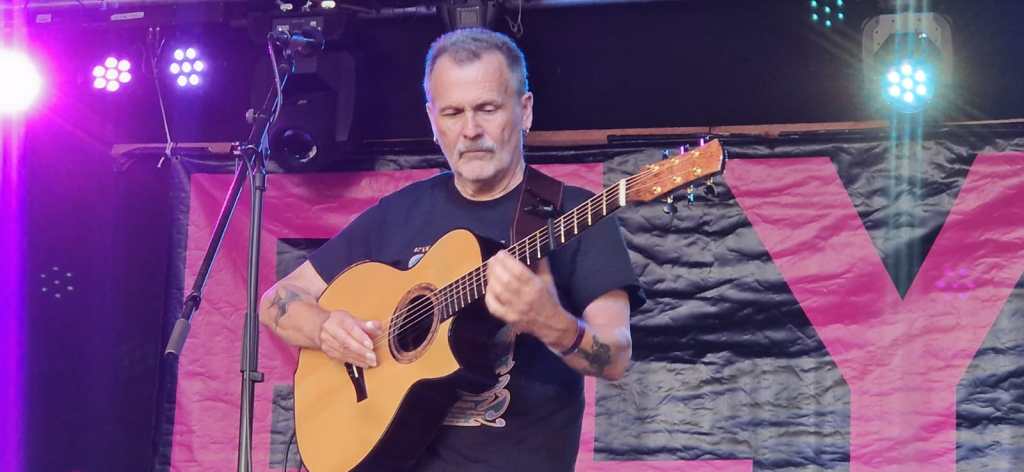
And so, as the festival winds down I end where I begin, in the intimate surrounds of the Nightingale Stage and the connection of some pleasing, folk purity in the shape of Jolene & The Leaves Of Life. Here again it is the rough edges that bring a human touch, Jolene at one moment gets a fit of the giggles and later takes four run-ups at a Ewan MacColl number but when she finds her feet, this set of material ranging from Fairport Convention to the Beatles is an absolute joy. Accompanied by Richard Partridge on upright bass and Monroe’s Revenge’s joke machine Joe Hymas on guitar and mandolin, Jolene Missing surely has the loveliest voice heard all weekend, one part Shelagh MacDonald another Anne Briggs, it is pure of tone and piercing in its conviction. This is a fitting end to a memorable festival in which, despite stiff competition from the warmest of sun-kissed weather, music has been the winner throughout. I cannot wait to see and hear what they serve up for the fortieth anniversary in 2026.


Reviewed by Danny Neill
 Fruit Tree Records