
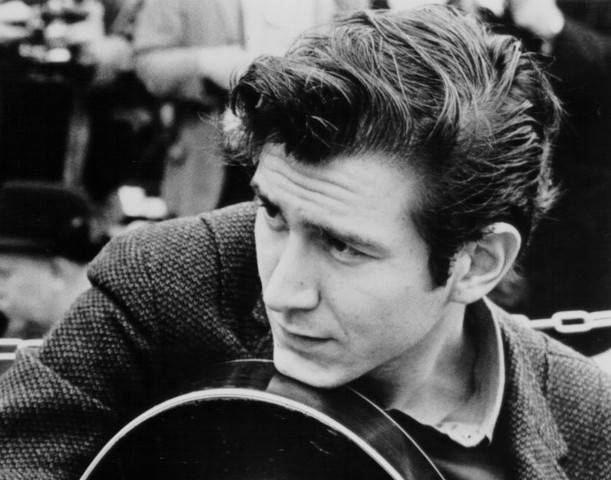
Phil Ochs – I Ain’t Marching Anymore
This week’s selection of older music recommendations is a feature inspired by the soon-to-land new Bob Dylan Bootleg Series Volume 18 box set. It offers a deep dive into the early Dylan period when he arrived in New York, soaked up the culture, history and political positioning of the folk scene around Greenwich Village and very soon became the most famous songwriter at the forefront of the protest movement. To compliment that, here are six tracks from some of the other musicians and songwriters Bob would have been rubbing shoulders with during this era. Many would influence Bob directly, some would collaborate with him whilst others, with Phil Ochs being the prime example, would motivate Bob more as artists he viewed as rivals within the topical song explosion. Dylan and Ochs had flashpoints in the mid-sixties (Dylan once booted Ochs out of a cab with the words “you’re just a journalist” ringing in his ears, his crime nothing more than, correctly, ascertaining that ‘Can You Please Crawl Out Your Window’ was not as good as Dylan’s previous release) but a mutually respectful connection did survive with Ochs often publicly defending against criticism of Bob’s adopting a folk-rock sound. Ochs tale is a sad one of mental health decline and a terminal downward spiral in the early seventies that he could not lift himself from. But, despite his lack of commercial success, Phil’s reputation must have held among peers. It is fascinating to hear on the new John Lennon set, focusing on Lennon’s own dalliance with protest music around 1971-72, how he jammed with Phil upon arriving in America, trying to find inspiration from the man clearly still regarded as one of the more effective, credible writers of this kind. One of the songs Phil played John that night was this, a pacifist classic from the mid sixties about turning away from military combat in search of another way, an idea that definitely chimed with Lennon’s own ‘War Is Over’ publicity campaign.
Carolyn Hester – Dink’s Song
Carolyn’s bit-part in the Bob Dylan story is quite a pivotal one actually. Her self titled album released in 1962 for Columbia featured Bob as an instrumentalist, playing the harmonica on some of the tracks such as ‘Swing And Turn Jubilee’ and ‘I’ll Fly Away’. Other than it being Bob’s first recording of any kind on a major label, it is also highly likely that it was this session that brought Bob to the attention of John Hammond, soon to be the man opening the doors to Columbia for Dylan to sign a first solo recording contract and make his own self titled debut LP. As can be heard on this selection, Carolyn had a fine voice and style of her own and with Davy Graham backing her on guitar, it is clear Dylan was only one of many folk legends she would work alongside.
Ramblin’ Jack Elliott – San Francisco Bay Blues
There is a funny detail within the pages of the new book that accompanies the latest edition of Bob Dylan’s Bootleg Series. It tells of the hilarity in Bob’s reaction to finding out the news that Ramblin’ Jack Elliott’s real name is Elliott Charles Adnopoz. Apparently the former Mr. Zimmerman, whose own backstory and its legitimacy, or lack of, would come into question soon enough could not help but fall about laughing. Ramblin’ Jack would be a key figure in Bob’s early development, with this own absorbing of the sound, manner and music of Woody Guthrie believed to be largely learned from Elliott. He was after all a man of whom Woody Guthrie himself said around this time “he sounds more like me than I do”.
Fred Neil – Dolphins
One of the real buried treasures of the Greenwich Village sixties scene was Fred Neil. A singer songwriter who seemed to have no commercial instinct whatsoever and displayed absolutely no interest in finding one. He is mentioned by Dylan in ‘Chronicles’ as being one of the first connections Bob would make upon his arrival in New York and he soon found himself backing Fred on harmonica. As a writer and performer this enigmatic singer really did have some gorgeous music up his sleeve, all delivered with that laid back bottomless baritone of a vocal. It was Fred Neil who wrote and recorded ‘Everybody’s Talkin”, a soon to be classic that rose to the top when sung on the ‘Midnight Cowboy’ soundtrack by Harry Nilsson. However, this deep floating ode to escapism and a simpler life swimming with dolphins is the song that Fred should be remembered for, it is a mid-sixties folk masterpiece with a grace and beauty that remains timeless.
Karen Dalton – It Hurts Me Too
There is a photograph of Bob Dylan playing harmonica with Fred Neil, as described in the intro to the previous song, which I shall feature at the end of this article. The female figure in between them is Karen Dalton, another artist who similar to Fred made some indelible, enduring records at the time but never gained much recognition and faded from view all too soon. Dylan once called her his favourite singer in the village and her mournful vocal style was often compared to Billie Holiday. Despite the appreciation of her peers, Karen was a reluctant performer and even more disinclined to play the kind of music industry games that were standard at the time in order to promote your work. Her two albums were released quietly in 1969 and 1971, in fact one is said to have been recorded in a single night session as if by accident, and a justifiably acclaimed reputation today has mainly arisen since her death in 1993 at the age of 55.
Malvina Reynolds – No Hole In My Head
With an image that suggested a safer, approachable grandmotherly figure, Malvina Reynolds presents as one of the more unusual and unique singer-songwriters of the period. Far from middle-of-the-road, her wonderful songs had a healthy bite and cynicism in their veins. One of her songs positioned Malvina as a happy failure in the world, comfortable with her status because “those that succeed are the sons of bitches”. She actually did not start writing music until her late 40s and made serious inroads in the folk scene thanks to the political punch in her lyrics and easy way with satirical, engaging storytelling lyrics. Her most famous composition was probably ‘Little Boxes’ sung by Pete Seeger but other artists covering Reynolds songs included Joan Baez, The Seekers and Harry Belafonte. Later on she also contributed compositions to the children’s show ‘Sesame Street’.

 Fruit Tree Records