
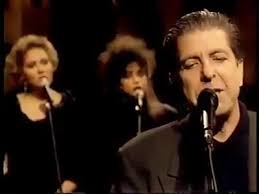
Leonard Cohen & Sonny Rollins – Who By Fire
This week’s journey through some vintage musical selections has a theme of unlikely or, as is the case with all six choices, very welcome collaborations. It was spurred by my chance encounter with our opening offering, a 1989 TV collaboration between a song writing icon and a free jazz legend. The programme which brought this pairing about was called ‘Night Music,’ hosted by David Sanborn and Jools Holland, a show well known for its matching of bright lights from seemingly opposite ends of the musical spectrum. This was an especially inspired pairing, as Rollins in tandem with Cohen’s backing singers and the Was (Not Was) band transformed the poets meditation on the fragility of life into a spiritual prayer of some considerable, freeform and exuberant, force. Best of all, behind that solemn face, you can easily detect Leonard’s delight in this transformative interpretation of one of his strongest works.
Nick Cave (with Toots Thielemans & Charlie Haden) – Hey Joe
‘Night Music’ was a new discovery to me and it turns out that pulling together unusual, first time, collaborators for live performances was one of its specialities. It was curated by Hal Willner and other intriguing sounding pairings included Conway Twitty with the Residents, Lou Reed & John Cale alongside Harry Connick Jr and Miles Davis (more on him in a bit) playing with the Red Hot Chili Peppers. For my other ‘Night Music’ pick today I have gone for this Nick Cave rendition of the sixties classic ‘Hey Joe’ because, once again, it speaks to oceans of untapped potential in the marrying up of deep singer-songwriters and the cutting edge of the bebop jazz world. Charlie Haden is a celebrated double bassist and composer who, among many other landmark appearances, had played on the 1959 ground breaker by Ornette Coleman, ‘The Shape Of Jazz To Come.’ And if that were not enough it also features the man routinely titled ‘the best harmonica player in the world’ Toots Thielemans and a very early televised sighting of Nick Cave playing with his long time band mate Mick Harvey.
Amy Winehouse & Paul Weller – Don’t Go To Strangers
This one is from the days when Jools Holland’s ‘Hootenanny’ on New Years Eve still had the capacity to delightedly overwhelm with its musical guests and match ups. Taken from the 2006 edition and capturing Amy at the end of a year that regrettably would prove to be the peak of her powers before they were tragically cut short. Together these two real-deal performers covered ‘I Heard It Through The Grapevine’ in addition to this sympathetic rendition of a song originally heard in 1954 by The Orioles. It gave Amy a chance to once again flex the jazz stylings she had been known for when breaking through only a few years before and Paul an opportunity to prove what a jazz-soul connoisseur he is at heart. It is wholly understandable when watching back that this should be one of the all-time great appearances on the long running show and one that many frequently refer back to.
Anne Briggs & Bert Jansch – Go Your Way My Love
I include this one simply because any filmed appearance by the reclusive, legendary folk singer Anne Briggs is a super rare thing and to be treasured. She recorded a pair of albums during her time as an active artist in the sixties and early seventies, both highly regarded and influential to all leading names in folk these past fifty years and beyond, even bands like Led Zeppelin were indebted to her. But she retreated from public view permanently in the early seventies never to re-appear, save for this short, soon to be terminated, moment at the start of the nineties when she briefly indulged requests with an occasional appearance. One of those is here where she was filmed with guitar legend Bert Jansch at the old ‘Howff’ Folk Club on The Royal Mile, Edinburgh, for the 1992 BAFTA nominated music film documentary ‘Acoustic Routes.’
Miles Davis & John Coltrane – So What
Not strictly a double billing because John Coltrane was a part of Miles Davis first famous quintet from 1955 onwards and then, by the time Miles was laying down his ‘Kind Of Blue’ masterpiece in 1959, Coltrane was a long established and vital member of the group that, by then, was a sextet. This is of course the opening track from that classic album which also boasted a jazz heavyweight line up in the other players, featuring Cannonball Adderley on alto sax, Bill Evans and Wynton Kelly on piano, Paul Chambers on bass and Jimmy Cobb on drums. In any other genre more would be made of two legends in the form appearing side by side like this on a record that, still today, is regarded as one of the greatest in the music’s history. Jazz can be more about respecting the music as much as the stars but still, for anyone that finds it an impenetrable genre I would point them to ‘So What’ and say just go from there. If something as timeless and wonderful as this does not pull you in, then get yourself another interest, music is not for you!
David Bowie & David Gilmour – Comfortably Numb
From a 2006 show at the Royal Albert Hall when David Gilmour was touring in support of his recent superb return to form solo album, ‘On An Island.’ Bowie had been out of the spotlight for a couple of years by this point following a health scare that prematurely terminated his ‘Reality’ tour. Little did we know at the time that his gentle return to public view in 2006 was not a step back into full time activity but instead the prelude to a final decade spent entirely out of the spotlight (save for the two late album releases prior to his death). It is of course understandable after the onstage trauma he had been through if he was reluctant to put himself in that situation again so, therefore, we are fortunate that this occasion was captured on film. If nothing else it shows the power of the man that he could, as near as possible, turn arguably David Gilmour’s signature Pink Floyd contribution into a David Bowie song for one night. Not that Gilmour did not step up and stamp his mark on it by the end too, both were on dazzling top form for sure.
 Fruit Tree Records