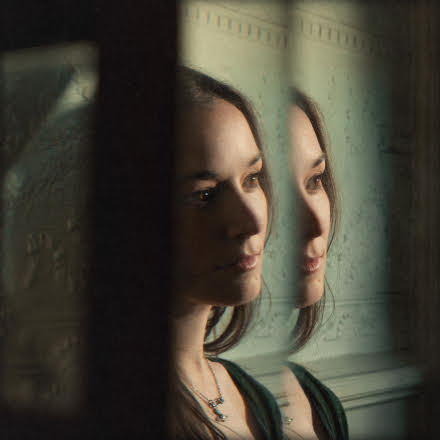
Around the release of her fourth full length album, the follow up to 2023’s highly rated ‘Echo The Diamond,’ Margaret Glaspy has been musing on her place in the world as a working musician. She is turning away from notions of success that are the accepted measuring tools, thinking of what she does instead as more of a public service. “You show up in city after city and you bring the music with you” Margaret ponders, “and hopefully it reaches whoever needs to hear it. I feel very honoured to be of service in that way.” Maybe this purity of intent is an indication of why this album stands tall with such undeniable effect. This is a work that plays as if all obstacles on the pathway to creation were aggressively swept aside, there is something in these songs that has more focus and indeed more hair-raising stimulants than we had any right to anticipate. At times there appears to be so much raw emotional detail in some of the lyrics that you could reasonably assume that this singer is emerging from a period of intense personal trauma, although the pre-release declarations from the artist herself all lean towards these being fictional, song writing excursions, albeit from someone more than capable of stitching a few authentic real morsels into the scenarios she sings about.
Also, if this were to be the Margaret Glaspy equivalent of Bob Dylan’s ‘Blood On The Tracks,’ (there is plenty of evidence that he is a big influence, especially in some of the wild and free harmonica playing we hear here) then it is a homage that respectfully understands the appeal of zooming in from a multitude of different perspectives. These audio vignettes have fine brush strokes that rarely nail moments down, preferring to play with time and chronology, prompting the curious effect of getting to the heart of the matter more than once. Part of this directness is attributed to Glaspy’s self-imposed release from the grip of social media. She saw this as a route back to original thought, not to mention some clarity of purpose, and sketched out these songs first with pen and paper before doing some even more retro polishing on a typewriter. This momentum is captured in the immediacy of the final work, produced by three-times Grammy winner Joe Henry. There is a fearlessness to the simplicity in some of the hooks, a confidence to play the notes that serve the narrative best and are guaranteed to reel in the listeners. Beyond that, there is a strength evident in the indie-leaning, acoustic warmth that has been captured, as Margaret alludes to herself when saying “I always think of myself as more of a photographer than a sculptor in the studio. It’s about capturing the moment rather than layering and building things up over time.”
Opening track ‘Michigan’ parachutes us into the troubled emotional terrain that bubbles across the surface of the whole album. “You said you didn’t need me, but who’s standing in whose driveway?” Potent lines like this enrich the whole track, emanating from the broken-hearted thoughts and deeds that permeate a recent relationship break up. It is writing of a fine crafted stripe, offering the suggestion of a narrative but exploding with moments that possess a universal familiarity that people are bound to identify with. ‘That Rose’ plays around with perspectives too, this time resulting in an album highlight, a sly reminder that jealous feelings are not exclusive to the betrayed. ‘Reminder,’ by contrast, feels like a peephole into the singers’ inner monologue, evaluating her place in the world and recalibrating all the coping strategies we need to survive, it is a do not throw your hand song that ducks and weaves rather than go for the knockout. At other times Margaret hits her targets with lethal precision, like on the beginning of ‘Petty’ with its seething opening line “can’t you read my mind? I thought telepathy was a requirement for love.” ‘Common Ground’ ploughs through the debris of shattered love too but like so much here, is lifted by the life affirming grit of the music.
‘James And Marie’ walks a more traditional storyteller line, especially by naming the lead characters from the outset, but again the momentum of the acoustic rhythmic riffing pushes the track into another realm far away from standard acoustic balladry. The subject matter takes on a wider brief with ‘Martin Luther King Jr.’ wherein Glaspy recontextualises segments of a 1957 sermon by the legendary civil right leader. Finding inspiration from his transcendent speaking, she shines a light on the truth in his words and their pertinence in modern day America and the world over. By the time we close on the title track, it feels like Margaret has arrived at a moment of self-enlightenment. The song is based on a female character that the writer looks up to deeply, a multi-faceted character with a real clarity of thought. But maybe she is also seeing a little of herself in there too? Or at the very least the person she aspires to be. All I can conclude is that, on this evidence, Margaret Glaspy is fast evolving into an expressive artist who also contains multitudes, travelling on a significant upwards trajectory of her own, she presents as one of the most engaging musical troubadours of our time.
Danny Neill
You can get yourself a copy of ‘I Am Both’ via this link: https://margaretglaspy.bandcamp.com/music